






Manufacturing services

Manufacturing branding
Most manufacturer brands land in one of two places. Either the credibility-by-default version, which is the same “trusted partner, family-owned since 2026, quality products you can rely on” copy every competitor claims word-for-word, or the over-engineered version, which is a rebrand that imports a consumer-brand aesthetic into a category where the audience reads it as a tell that you don’t actually understand industrial buyers.
Real manufacturing branding does load-bearing work. It’s what gets you onto the bid list before pricing happens. When three vendors quote the same spec at within five percent on price, brand is the tiebreaker on every other axis: who looks like they’ll still be in business in seven years, who looks like they’ll honor the warranty when something fails at month thirty-eight, who looks like they’ll have engineering support available when the integration gets tricky. The pattern we see most often is that manufacturers underinvest in brand because the buyers are “rational.” The buyers are rational. The brand is what the rational evaluation runs through.
For a smaller manufacturer competing against the industry giants in a category, brand is also the thing that makes a sharper, faster company look credible against a bigger, slower one. New customers meeting you for the first time aren’t just asking “is this product good?” They’re asking “why haven’t I heard of these people, and should I take that as a problem or as a sign that I’m finding them before everyone else does?” The brand answers that question before the spec sheet does.
The visual identity work has to clear specific manufacturing-category traps. Stock photos of factory floors with depth-of-field bokeh. Hero shots of CNC machines that look like every competitor’s hero shot of CNC machines. Capability page photography that’s clearly composited. Engineers and operations leaders see through that immediately. Real photography of your actual work, your actual people, your actual facility, with art direction that signals the level of care you put into the product, beats glossy stock every time.
Messaging architecture matters because you’re addressing multiple audiences with different vocabularies on the same site. The engineer wants validation language: standards met, tolerances held, certifications earned, problems solved at the application level. The procurement officer wants risk language: business stability, on-time delivery history, quality systems, references. The executive wants company language: reputation, fit, the kind of partner you’ll be after the order is placed. The brand has to support all three without sounding like three different companies.
Learn more about our branding services
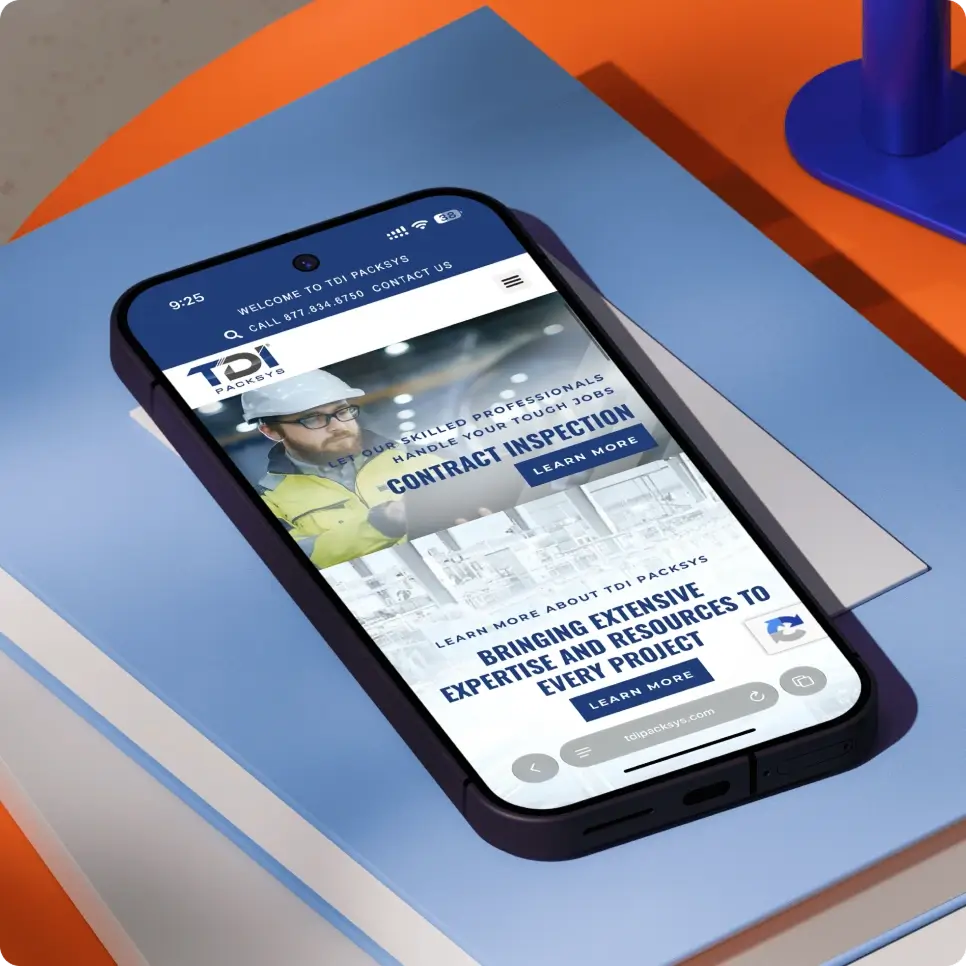
Manufacturing web design
Your website is doing the work your sales team can’t be everywhere doing. Your rep is in three states this week. Your distributor’s order desk closes at five. The engineer comparing your product against two competitors is on your spec page at eleven at night, with a deadline tomorrow morning, building the bid response. The site is the only thing always in the room.
The structural problem most manufacturer websites have is that the same site has to serve three different readers with different decision criteria. The engineer is evaluating technical fit: does this product hold the spec, what are the dimensions and tolerances, what does the cut sheet look like, does it integrate with the existing line, what are the failure modes. The procurement officer is evaluating risk: is this company stable, what’s their delivery history, what certifications do they carry, what does their quality system look like. The executive is evaluating the company itself: do they look like the kind of supplier I want my name attached to. One site, three readers, three different decision paths the architecture has to support without any of them feeling like an afterthought.
We rebuild manufacturer information architecture around how technical buyers actually shop, which is rarely how the catalog is organized internally. Sites organized by model number force a buyer to already know what they want before they can find it. Sites organized by application, by industry served, by problem solved, let buyers self-route into the part of the catalog that matches their situation. One reorganization we ran for a 100-plus SKU industrial equipment catalog moved navigation from product family code to application and industry served, with technical content for each application sitting next to the product. Buyers who walked in cold could actually find their product. Organic visibility followed because the new architecture matched the way technical buyers actually search.
Performance and accessibility get framed as engineering quality on this category. A manufacturer site that loads slowly, breaks on mobile, or fails accessibility standards signals the same thing as a quality issue on the production floor: you don’t sweat the small stuff, which means I should worry about how you’ll handle the big stuff. Spec sheet PDFs that download cleanly. Product comparison tables that render right on every device. Schema markup that lets your products surface correctly in search and in AI engines. Technical buyers register the difference whether they consciously notice it or not.
Conversion is calibrated for long-cycle B2B. Tap-to-call works for emergency plumbers; it does almost nothing for a six-month industrial capital equipment evaluation. The signals that matter are spec sheet downloads, product page deep reads, return visits to the same product over weeks, request-for-quote forms with technical detail, and consultation requests from engineering contacts who already know what they want. The site is built to convert at the cycle’s actual pace, not at a pace that doesn’t exist.
Learn more about our web design services
Manufacturing marketing
What gets optimized wrong in manufacturing marketing is “leads.” Every agency promises more leads. Lead volume is the wrong primary metric for a category where one specified-into-the-project win on the right OEM contract is worth a year of unqualified inquiries from procurement assistants asking for catalogs.
The right anchor metric is whether you got specified into the project. Marketing-influenced deals, not marketing-sourced leads. The engineer who put your product into the bid spec didn’t fill out a form first; they searched for a solution to their application, found the right resource on your site, downloaded the spec sheet, integrated it into their drawing, and the procurement RFQ that landed in your inbox three months later already had your name in it. The win was made before the lead form fired.
Distributor and channel education is its own marketing program for manufacturers that sell through reps or distributors, and most agencies miss it entirely. Your distributors are a sales channel and an audience at the same time. The content that helps your distributor’s sales team explain why your product wins on a specific application is doing real revenue work, even though no end-customer ever sees it. Sales enablement materials, application guides, comparison content the rep can use in a customer meeting, training content that shortens the ramp on a new product line. The agency that doesn’t think about distributor enablement leaves a category-specific lever on the table.
The senior expertise question matters more in manufacturing than in any other category we work in right now, because the AI-generated-content pitch wave is hitting manufacturing hard and falling apart in specific, measurable ways. The pitch sounds reasonable: “we’ll generate product pages and spec content with AI at scale, you’ll cover ten times the keyword surface for a fraction of the cost.” What actually happens is that AI hallucinates technical specifications it doesn’t have ground truth on. It writes confidently wrong dimensions, materials compatibilities, voltage ranges, and certification claims. Engineers catch it on the first read. The page that looked great in a content audit gets your product disqualified from the spec sheet because the buyer doesn’t trust the source. We use AI heavily on our side: research synthesis across hundreds of competitor pages, faster discovery analysis, content production scaffolding, technical writing acceleration. Senior practitioners who actually understand industrial product content review every claim before it goes live. The category-fit metric isn’t traffic; it’s whether technical buyers trust what they read enough to spec it in.
The compound dynamic on manufacturing is real and slow. The content libraries you publish this year drive specifications in projects that close two years from now. The search authority you build on application-specific terms compounds into AI-engine citations on the same terms. The case studies you publish from one OEM win get used as proof points to win three more OEM contracts. None of that shows up in a quarterly report; all of it shows up in a year-three pipeline that didn’t exist before. This is the agency problem the non-agency agency model is built to solve in this category specifically. Three separate vendors handling brand, site, and content can’t compound institutional knowledge across a four-year sales cycle when each vendor’s account team turns over twice in that window. One team that stays on the work, with the same senior people who learned your application categories, builds context that compounds instead of resetting.
Honest measurement is cost per qualified opportunity, cost per specification win, sales-cycle compression on deals the marketing engine touched, and pipeline contribution measured against the cycle’s actual length. Not MQL counts the sales team won’t follow up on. Not vanity traffic numbers. The metrics that show whether marketing is moving the business.
Learn more about our marketing services
Strategic advisory for manufacturing
Strategic advisory shows up when the question is bigger than execution. A new product line entering an adjacent market. A pricing repositioning when the category compresses. A go-to-market evaluation for a PE-backed acquisition. The decision about whether to invest in marketing infrastructure now or wait for the next budget cycle. The conversation about what changes when you’re trying to reposition from a contract manufacturer relationship into a brand-recognized direct seller.
Advising in manufacturing requires holding two timeframes in the same conversation. The cycle reality is multi-year: investments made now show up as wins eighteen to thirty-six months out. The executive pressure is quarterly: a family-owned manufacturer answering to next-generation succession, a PE-backed manufacturer answering to a fund’s hold-period clock, an operations leader answering to a board with quarterly visibility into the same business. The advisory work has to translate the long-cycle reality into the quarterly defenses the buyer has to make to stakeholders who think on shorter horizons.
The pattern we see most often is that advisory work in this category grows out of execution work rather than landing as its own engagement. Manufacturing buyers don’t hand strategic questions to advisors who haven’t proven they understand the category, and the proof shows up in delivery. The shape that tends to work: an engagement starts with a defined scope, the work demonstrates that we actually understand the application, the distributor channel, the sales-cycle reality, and the executive dynamics. Then the buyer brings the bigger questions to the same team. Repositioning calls, channel strategy decisions, build-versus-partner evaluations on adjacent product lines. Advisory at that point isn’t an outside consultant arriving with a deck. It’s the team that already understands the business being asked to think alongside leadership about what’s next. The brain comes with hands, and in manufacturing, the hands earn the brain its seat at the table.
What you walk away with depends on the engagement, but typically includes a positioning recommendation grounded in real category research, a sequenced investment roadmap with realistic phasing, and the rationale behind each call so you can defend it to your leadership, your sponsor, your board, or your family ownership. Sometimes the recommendation is to do nothing yet. Sometimes it’s to fix something else first. Sometimes it’s to recommend against the engagement we’d be hired for. Operator-level honesty about what the market actually rewards beats a pretty deck that ages badly.