• Menu About Connective
  • Menu Core Values
  • Menu Reviews
  • Two person giving high five

Focus

Healthcare IT company goes from invisible to category-defining brand and market presence

From “we can’t explain what we do in 10 seconds” to owning a market position validated through competitive research. It started as positioning. Then we applied the same foundation across identity, sales materials, content, video, PPC, trade shows, and a podcast rebrand. One strategy, reused everywhere. Website redesign is already underway.
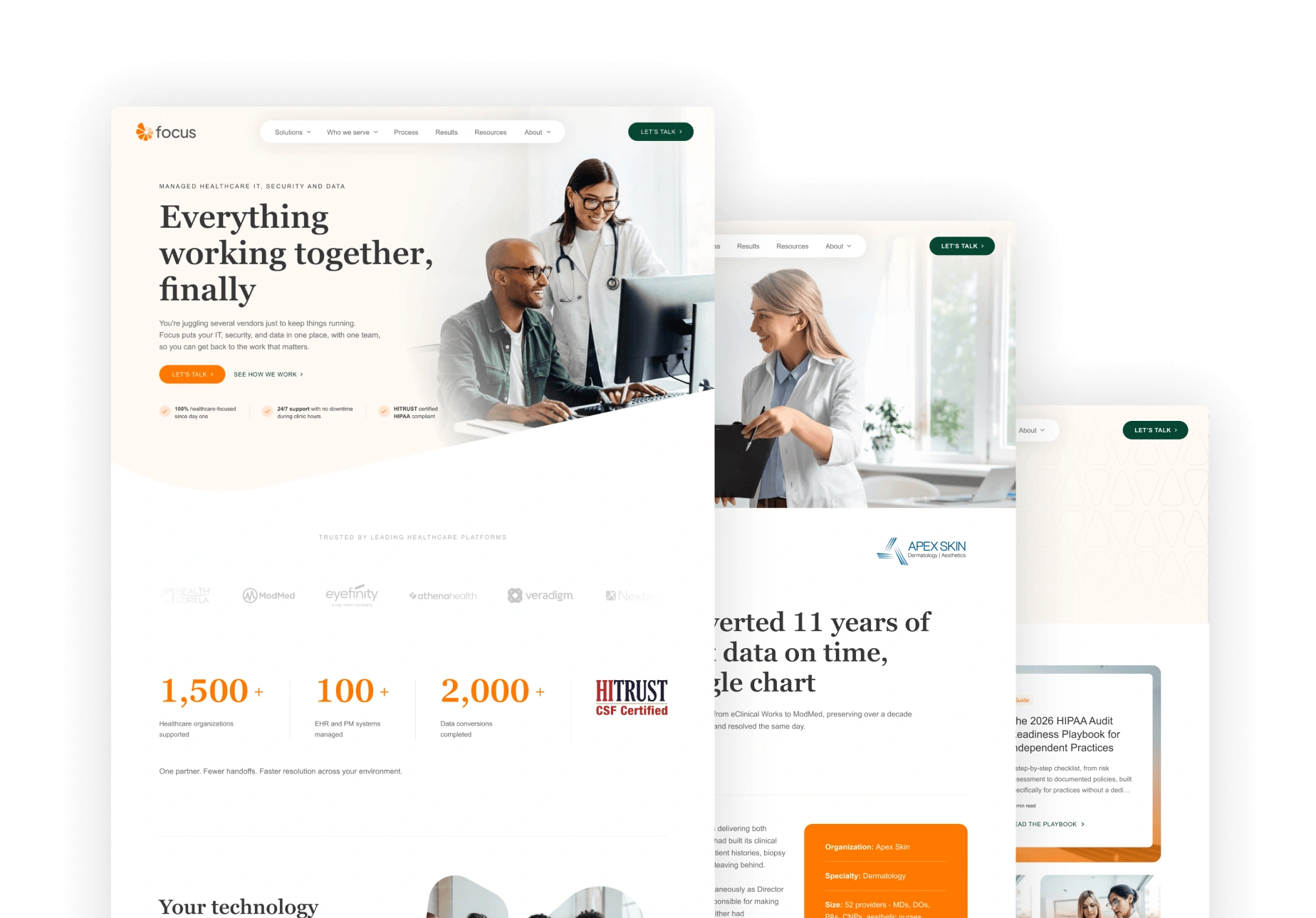
The new focus solution website layout

At a glance

Here’s the short version for those evaluating whether this project is relevant to their situation.

"Best ever seen"

Leadership advisor's review after working with 6 other agencies on brand strategy

Ownable position

From "another MSP" to Unified Partner with a clear, defensible claim

Full alignment

Sales, leadership, and delivery teams speaking the same value story

78% owned marketing assets

Brand system, sales tools, content, video, trade show materials, podcast. Assets they retain and use without us.

The core insight: The real competitor wasn’t another MSP. It was the category itself. As long as Focus got filed under “managed IT,” their most valuable differentiation never made it into the conversation.

This case study is for companies with complex service portfolios that keep getting flattened into a generic category.

The challenge they faced

What they’d built

Focus Solutions had built something real over 15 years. They weren’t “another MSP.” They were the only healthcare-focused IT company in their market combining managed IT and data services under one roof, built organically as one team. 1,000+ clients served. 50+ employees. The kind of deep healthcare and technical experience that matters in regulated environments.

Why it wasn’t landing

Their messaging flattened everything into generic managed services language. The brand had been created by founders years ago without strategic foundation. Multiple website redesigns hadn’t solved the underlying problem. Sales conversations drifted into technical jargon instead of business outcomes. Even internally, the team struggled to explain the value clearly and consistently.

What it cost them

The price showed up everywhere. Search visibility stayed low. CTAs were vague (“Learn More,” “Let’s Talk”) instead of results-oriented. Competitors with less differentiated offerings were outpacing them in market presence simply because they sounded clearer.

For a company that had genuinely built something no competitor offered, this was a positioning crisis. They weren’t just invisible. They were trapped in a category that undersold everything they’d built.

The CEO put it directly: “We don’t have a succinct way within 10 seconds of communicating what we do and the value we provide.” That became our design brief.

How we approached it

What discovery revealed

Before creating a single brand concept, we needed to understand what made Focus Solutions actually different. Not what they claimed. What was true.

We interviewed every department head in extensive Q&A sessions. Sales, delivery, leadership. We audited direct competitors and mapped how they positioned themselves across messaging, visual identity, and content.

Three insights shaped everything that followed:

The integration was structural, not marketing. No direct competitor offers fully integrated, healthcare-specific IT, data, applications, and security services developed organically under one roof. That integration wasn’t a feature. It was the position, and competitors can’t copy it without changing how they operate.

Their internal language was already strategic. Phrases like “from bad to good,” “outcomes over outputs,” and “we don’t just fix, we enable” were already being used internally. The brand voice existed. It just hadn’t been codified or made external.

The biggest competitor was inertia, not another vendor. Focus often lost not to competing firms but to the client’s internal team. Organizations assumed operational inefficiencies were just the cost of doing business.
This reframed the entire strategy. We weren’t trying to make Focus Solutions sound like a better MSP. We were positioning them as something entirely new.

How services integrated

Brand strategy doesn’t happen in a vacuum. The positioning work needed to inform everything: visual identity, messaging hierarchy, content strategy, sales enablement. Every specialist on the team consumed the same discovery materials. Not filtered briefs. The actual research.

That shared foundation prevented the usual handoff problems. When our designers developed visual identity concepts, they understood the competitive positioning. When our copywriters drafted messaging, they knew which internal language had already resonated. When we planned content strategy, we had the competitive analysis showing exactly where Focus Solutions could own search territory.


Man discussing ideas with colleagues during an office meeting v2
Professional colleagues reviewing documents together on a laptop in an office

Category creation over incremental improvement

Rather than positioning Focus as "a better MSP," we repositioned them as something entirely new: a Unified Partner. This required research proving no competitor occupied this space. The risk was that new categories require education. The reward was an ownable position that couldn't be copied.

Develop a proprietary framework as brand asset

The Unification Framework (Fix → Stability → Enablement) does a lot of jobs at once: sales tool, internal alignment, content organizing principle, visual differentiator. One framework, reused across sales, content, and internal alignment.

Mine internal language before inventing new

Instead of imposing external brand voice, we codified what was already working in their conversations. The brand voice guide reflects how Focus Solutions actually talks when they're at their best, not marketing speak we invented.

Build foundation before activation

We structured the engagement in two phases. Foundations first: brand development, CRM integration, initial case studies, landing page framework. Then market activation: trade shows, sales materials, PPC campaigns. Building the engine before stepping on the gas.

What we built together

Brand strategy and foundation

Those department head interviews weren’t just for the initial strategy. They built institutional knowledge we’ve compounded ever since. Consistent meetings, feedback loops, context on their space. That depth lets us write and design with specificity that would be hard to fake from the outside.

Person reviewing logo concepts of focus solution company on a laptop with a colleague
Brand Visual Guide
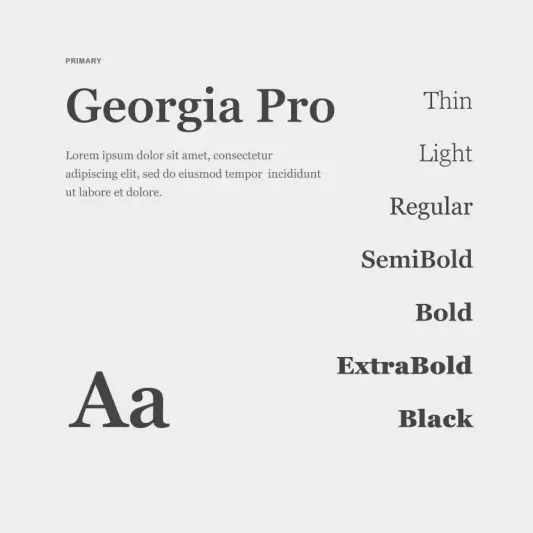
Georgia Pro typeface shown in multiple font weights
Primary Typography

Strategic positioning

We didn’t just write a tagline. We defined what category Focus Solutions actually belongs in, then built the language to claim it. The positioning statement comes in two versions: one for when you have 30 seconds, one for when you have 10.

The positioning statement:

For growth-focused healthcare organizations frustrated by fragmented systems and underwhelming IT support, Focus Solutions is your Unified Partner. We bring IT, data, applications, and security together under one roof to align technology with your clinical and operational goals.

Focus Solution website displayed on a laptop and smartphone
Focus Case Study Page

Content strategy

Complete site copywriting informed by discovery research. Service descriptions that address actual user questions and concerns.
Content organized to meet visitors wherever they are in their journey.

Healthcare technology website headline about IT, security, and data
Unified Partner Page Hero Copies
Person typing on a laptop displaying a target audience document
Discovery Guide

Proprietary framework development

The Unification Framework gives the whole team a simple way to explain where a prospect is and where they could go. Fix → Stability → Enablement. Three stages, clear language, works in actual sales conversations. Nine months later, the sales team still uses this in every prospect conversation. That’s the test of whether a framework actually works.

Stage

Core Pain

IT Behavior

ROI Impact

Fix

Disruption, frustration, lack of trust

Reactive, fragmented

Negative (reverse)

Stability

Flat performance, strategic disconnect

Predictable but passive

Neutral (coasting)

Enablement

Pressure to scale and innovate

Aligned, proactive, outcome-driven

Positive (accelerating)

Focus logo development from flag symbol to refined icon
Focus — Unification Framework

Target audience development

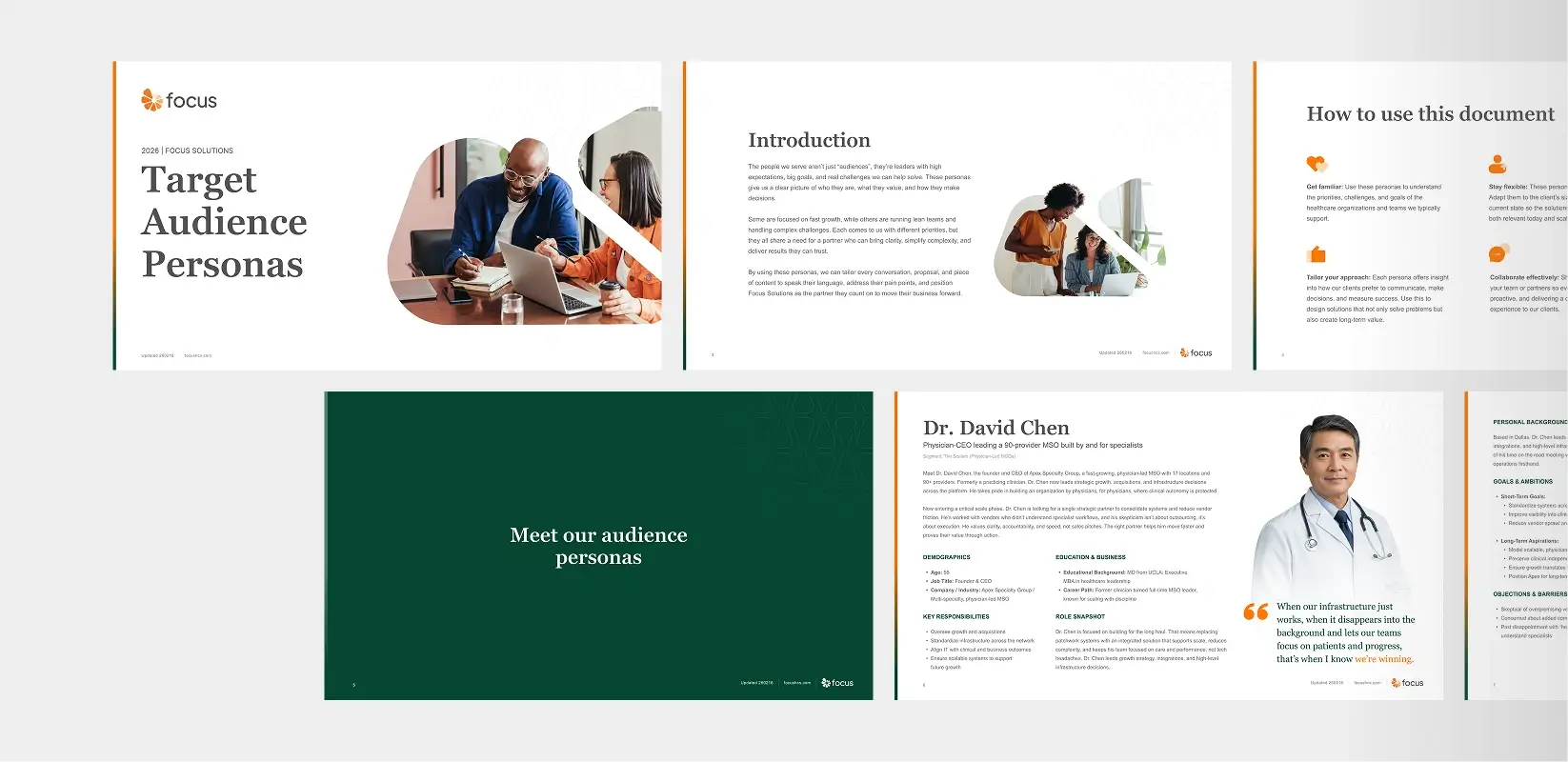
We built four personas from research, not assumptions. The Scalers are PE-backed or physician-led MSOs moving fast. Growth-Focused Independents are multi-site practices trying to expand without losing their identity. Strategic In-House Teams are IT-led organizations that want a partner, not a vendor. Each one has different pain points, different decision criteria, different things that make them say yes.

Target audience persona presentation slides for healthcare marketing
Focus — Target Audience Personas
Smiling professional featured beside a message about practical solutions
Focus — Target Audience Personas

Visual identity system

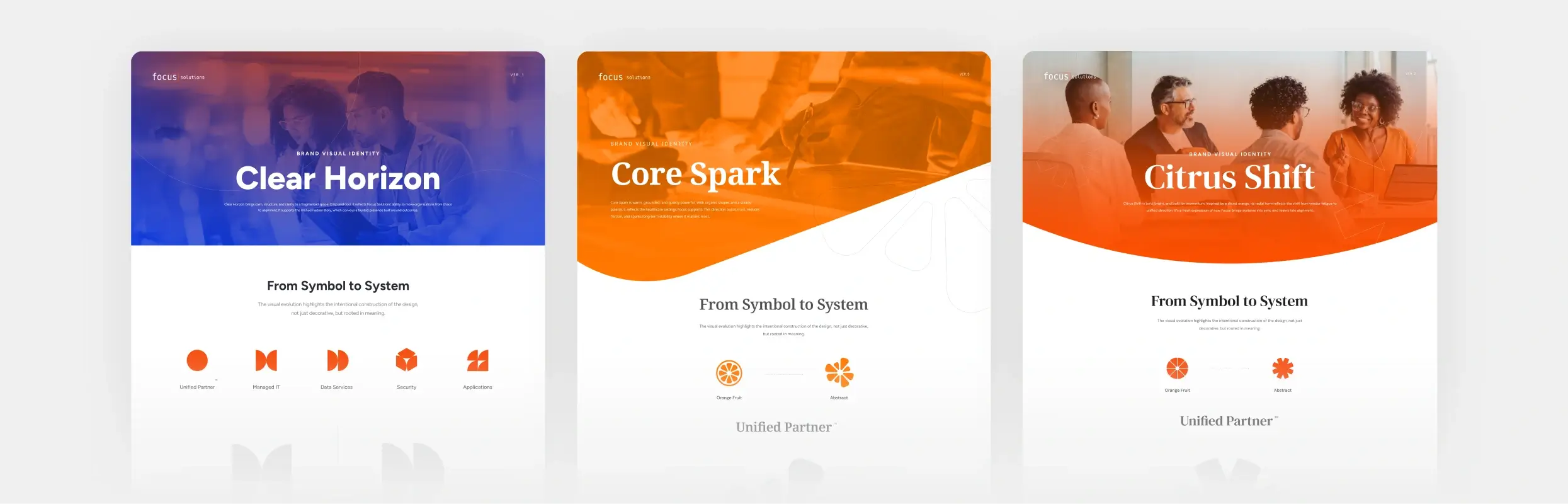
We explored three distinct creative directions before landing on the final system. The deliverable is everything their team needs to keep the brand consistent without calling us every time someone makes a PowerPoint: logo specs, typography, colors, icons, photography direction, sample applications.

Brand concept boards showcasing three creative visual directions
Three Brand Concept Explorations

Brand voice and messaging

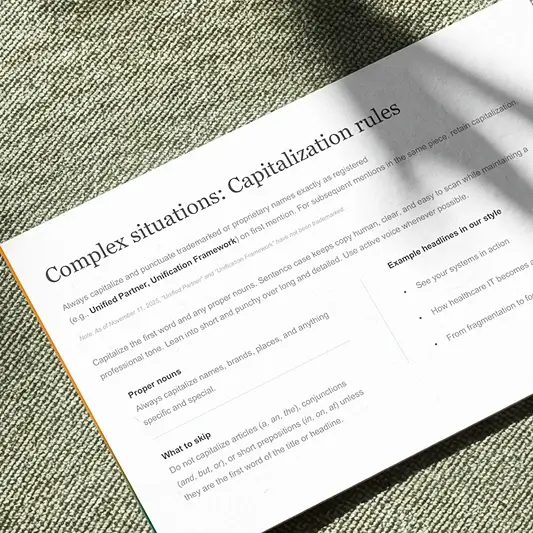
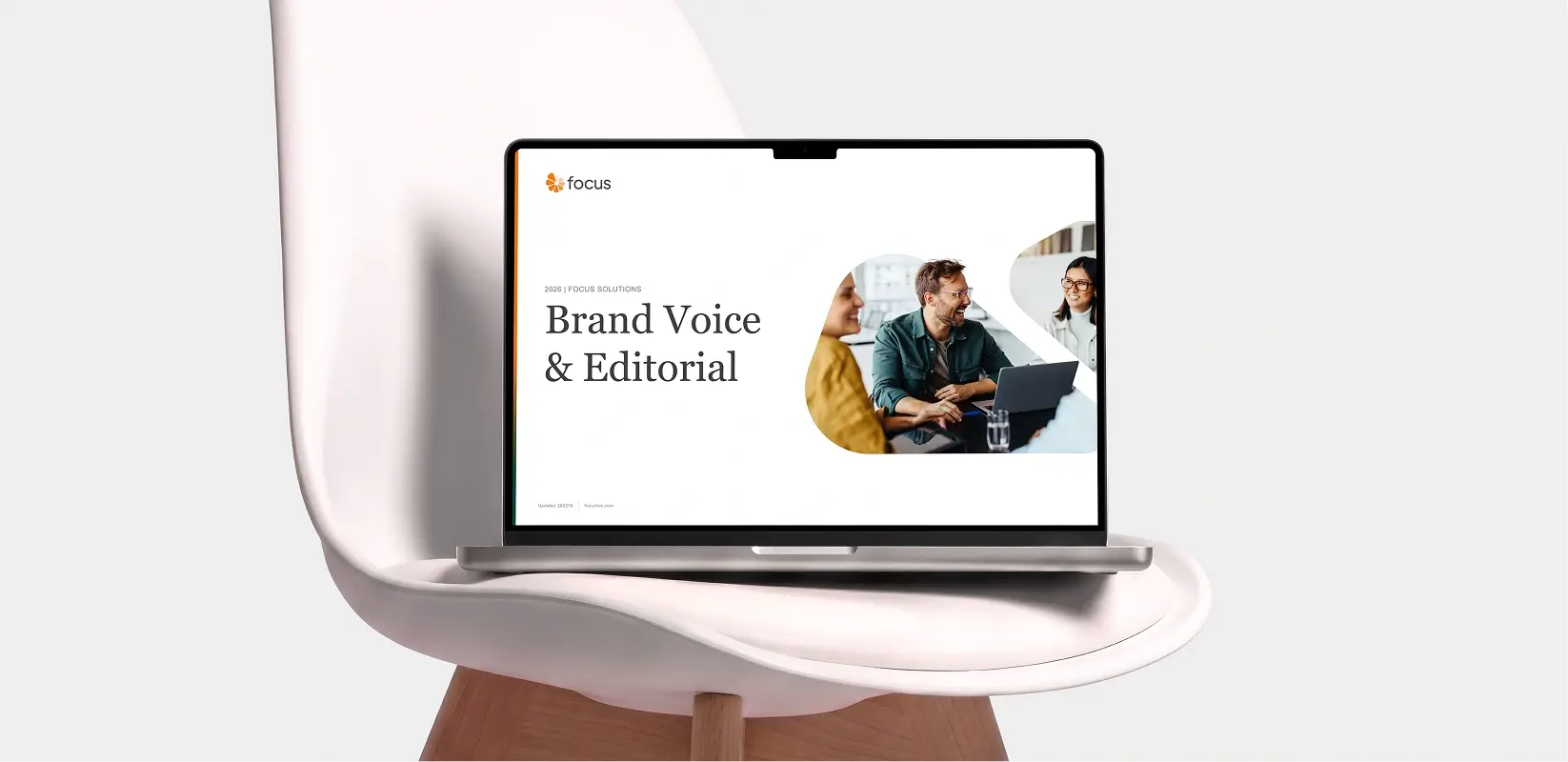
We codified how Focus Solutions sounds when they’re at their best. The space between too casual and too corporate. What to say, what to avoid, how it changes across channels. A guide the team can actually use, not a document that sits in a folder.

Capitalization rules page from a brand editorial guide
Focus’ Brand Voice & Editorial Page
Focus Solution brand voice and editorial guidelines displayed on a laptop mockup
Focus’ Brand Voice & Editorial

Marketing execution (the compound effect)

This is where the brand foundation paid off. Once everyone understood the positioning, we could move fast across channels without relitigating strategy every time. This is what a fractional marketing department looks like: cross-functional expertise deployed as needed, without building an in-house team.

How the strategy compounded:

  • Positioning clarified what they are (Unified Partner)
  • Framework made it explainable (Fix → Stability → Enablement)
  • Identity made it consistent across touchpoints
  • Sales tools made it sellable
  • Content and campaigns made it discoverable

From there: a content engine leveraging their own topic experts (HIPAA, cybersecurity, ransomware, MFA, social engineering, AI risks). Complete sales toolkit. Four client case studies. Brand reveal video and 25+ webinar clips. 12+ landing pages. Email campaigns, Google Ads, PPC. Trade show presence at Momentum/ModMed and Athena with full booth design and collateral. Podcast rebrand for “Vital Conversations” with new episodes, new intro/outro, and distribution setup.

Person reviewing the Focus Solution new color palette on a tablet
Focus Brand Visual Guide — Color Palette Page

Where they ended up

“Best ever seen”

Leadership advisor’s verdict after working with 6 other agencies on brand strategy

“No one looks as good”

Client’s assessment: no competitor in their market matches their positioning or brand quality

Full alignment

Sales, leadership, and delivery teams speaking the same value story

2026 and beyond

Partnership expanding into website redesign and continued execution

The outcomes go beyond deliverables.

Before: A team defaulting to technical jargon when talking to prospects, trapped in a category that undersold everything they’d built. No shared language. No framework for explaining value.

After: A shared language and framework the entire company uses. Sales conversations that lead with outcomes instead of features. A competitive position no one in their market can easily copy. And a foundation that enabled execution across every channel: landing pages, blog content, videos, case studies, sales slicks, trade show presence at two major conferences, podcast rebrand, PPC campaigns, email automation, and CRM integration.

The leadership advisor validation matters here. Someone who had worked with 6 other agencies on similar brand work looked at what we built and called it “the best he’s ever seen.” That’s not our opinion. That’s an external expert’s judgment after comparing against alternatives.

Every investment built on the one before it. Brand strategy created shared language, which informed visual identity, which enabled consistent sales materials, which supported trade show presence, which generated content, which fed email campaigns.

Approximately 78% of the engagement investment went to owned marketing assets: brand system, sales tools, content, video, trade show materials, podcast. Assets Focus Solutions retains and uses without us. These continue supporting lead generation and sales enablement independent of any ongoing agency relationship.

The partnership continues into 2026 with a full website redesign. When you’ve built a brand foundation this solid and accumulated this much context about a client’s business, the website becomes execution of strategy rather than another attempt to figure out who you are.

Frequently asked questions

Common questions about website consolidation and nonprofit redesign projects

Depends on how complex your organization is and how many stakeholders need to weigh in. Discovery alone takes several weeks when done properly. For Focus Solutions, we moved from kickoff to strategy presentation in about three months, with execution continuing through the rest of the year. We’d rather give you an honest timeline af

A logo is one output of brand strategy, not the strategy itself. Brand strategy defines who you are, who you’re for, why you’re different, and how you talk about it. Visual identity expresses that strategy visually. Without the strategic foundation, a new logo is just a new picture.

This is exactly what brand strategy is for. The challenge isn’t usually that services are too complex. It’s that there’s no unifying framework to explain how they relate. We develop frameworks and language that make complex offerings understandable without oversimplifying them. The Unification Framework we built for Focus Solutions is a good example.

Depends on what you do with it. If brand strategy produces a PDF that sits in a folder, it’s an expense. If it becomes the foundation for everything else, it’s an investment. For Focus Solutions, 78% of the engagement investment went to owned marketing assets: brand system, sales tools, content, video, trade show materials, podcast. Assets they retain and use without us. That’s the difference between paying for a project and building infrastructure.

We build on existing work rather than ignoring it. For Focus Solutions, we interviewed every department head to understand what had been tried before and what was already working. Good insights don’t expire just because another firm uncovered them. Our job is synthesis and application, not starting from scratch to justify our involvement.

The most meaningful measures are often qualitative: Can the team explain the value proposition confidently? Do prospects understand the differentiation? Is there internal alignment on positioning? We also look at downstream metrics as marketing execution builds on the foundation: search visibility, lead quality, sales cycle length. But brand strategy success is fundamentally about clarity and alignment, not just numbers.

Because positioning decisions made without research are just opinions. We need to understand your competitive landscape, your actual differentiation, how your audiences think, and where opportunities exist before we can make strategic recommendations. Research prevents expensive mistakes from applying assumptions instead of insights.

For some clients, we hand off brand assets and guidelines for their internal team or another agency to execute. For others, the brand foundation becomes the starting point for ongoing marketing partnership. The Focus Solutions engagement expanded into content marketing, sales enablement, video production, PPC, and eventually website redesign. Either path works depending on your needs and internal capabilities.

Often, yes. Larger competitors tend toward generic positioning because they serve broad markets. Mid-market companies can claim more specific, differentiated positions that larger players can’t credibly own. Focus Solutions competes against companies with bigger marketing budgets. Their advantage is a position those competitors can’t copy: genuine integration of services they’ve built organically over 15 years.

Regular communication, not quarterly check-ins. Strategic guidance as situations evolve. Execution support across marketing channels. For Focus Solutions, we provided fractional marketing department capabilities: access to a cross-functional team of specialists without the overhead of building that team internally. The scope expanded naturally as trust was established through results. And every meeting, every feedback loop, every campaign builds context that makes the next deliverable sharper and faster.

Want to learn more about B2B brand strategy?

Explore our insights on positioning for complex service portfolios

Illustration of a person writing notes while holding a phone beside a calculator and desk items

Explore more case studies

See how research-driven methodology delivers measurable outcomes across different industries and challenges.

Or if you’re ready to discuss your situation, let’s have a conversation about whether this approach fits your needs.