Your interface earns compliments, but your users still abandon
The pattern we see most often in UX/UI conversations starts the same way. The site looks good. The team is proud of how it landed in design reviews. Then the analytics show users abandoning the same flows they always abandoned, support tickets coming in about the same friction that was supposed to get fixed, and the conversion rate sitting where it was before the redesign. The interface changed. The behavior didn’t.
What we usually find is that the problem wasn’t on the surface. It was upstream. The visual design got new attention while the information architecture (IA) stayed roughly what it was. Or research happens in one team, wireframes in another, visual design in a third, and every handoff thins the strategic context until the final interface is solving for design coherence rather than user behavior. By the time the site shipped, the people closest to the user research had been off the project for weeks.
The fixes most teams reach for are tactical. A larger CTA. A cleaner hero. Reordering the form. Sometimes the metric moves a few percent. Usually nothing meaningful happens. The interface wasn’t broken because of any one element. It was solving the wrong problem.
A real UX/UI engagement is structural work, not surface work. It’s the discipline of getting research, IA, interaction patterns, and visual execution to ship as one connected view of how the site needs to work for users.
How we think about UX/UI
Most UX/UI work fails on one of two ends: polished interfaces nobody validated against how users actually behave, or research deliverables that get filed and ignored when the design team picks up the work. We build engagements where research, IA, and interface aren’t separable phases handled by separate teams.
Strategy is the design

Most agencies start UX/UI engagements by opening a design tool. We start by understanding why the site needs to exist for users in the first place: voice-of-customer mining from sales transcripts and support tickets, competitive IA analysis, analytics review of stakeholder assumptions against what users actually do. The design becomes the artifact of that thinking, not a substitute for it.
Audience-based architecture, not org-chart navigation
Many sites organize around the company’s internal model: service lines, departments, legacy categories. Those conventions work only when they match how visitors actually look for answers. We organize around who the visitor is and what they’re trying to accomplish, so navigation labels match the language the visitor used to search, not the marketing team’s internal terminology.
Senior judgment, amplified by AI
AI-generated interfaces are everywhere right now, polished in minutes. What they miss is the operator judgment that decides whether the interface actually works: three identical box layouts, default CTA copy that doesn’t match the brand voice, framing that defaults to acquisition when the business runs on referrals. AI is the fastest collaborator in the room, not the smartest. Senior people stay on the engagement; AI compresses the analysis work.
Same team, research through design
Most UX/UI work fragments at the handoffs. Strategists who ran discovery hand findings to designers who didn’t read the research; designers hand wireframes to UI specialists who weren’t in the IA conversations. We staff engagements so the same senior people who shape the research stay on through visual design and developer handoff.
If you owned this engagement and could pick anyone in the firm to make a call, the answer would be the senior practitioner who shaped the research, not a project manager translating between specialists. We staff the room that way by default. Decisions happen with the people who can act on them, not in the layer between you and them.
What a complete UX/UI engagement actually includes
UX/UI work spans research, structural design, and visual execution. Most engagements happen inside a full website build where the same team owns each layer. Standalone scopes work too when the situation calls for it.
Research and discovery
Before we touch a wireframe, we build the evidence foundation every downstream decision draws from: stakeholder interviews, voice-of-customer analysis from sales transcripts and support tickets, competitive IA review, analytics review, and persona work that maps distinct journeys for each audience the site has to serve. On a recent engagement for a mental health nonprofit, the persona work shaped the navigation, the content hierarchy, and the emotional register of every section before any wireframe was drawn.
Information architecture and user flows
How the site is structured determines whether users find what they need or bounce. Sitemap development that goes beyond copying competitors and looks for positioning opportunities, user flow mapping for each persona, and a strategic IA blueprint documenting where the structure follows convention and where it breaks convention deliberately. IA is the strategy; the sitemap is one tactical output of it.
Wireframes and prototypes
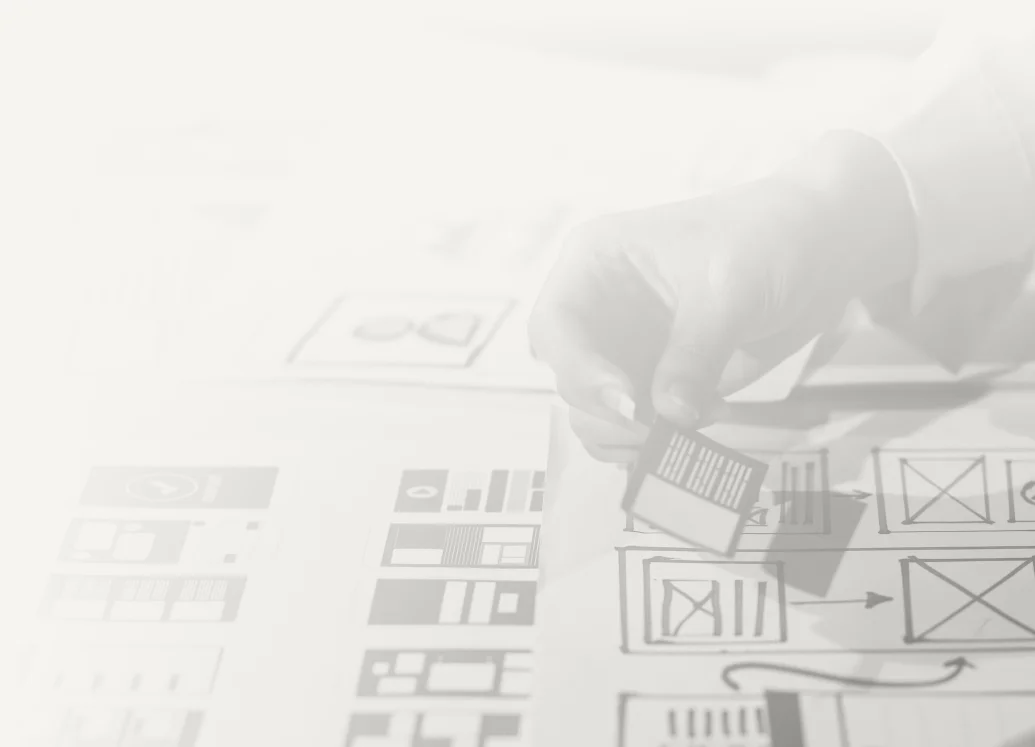
Wireframes get approved in sequence: homepage first, then inner page templates after the design system is locked. The homepage typically receives the most concentrated attention because every downstream decision cascades from it. Interactive prototypes when the engagement involves complex flows or stakeholder validation that static wireframes can’t carry. Mobile gets equal weight in design and review, not bolted on at the end.
Visual design and design systems
Visual design serves the IA and the brand strategy, not the design tool of the moment. Typography, color, spacing, and component patterns get developed as a system that works across templates, not a homepage reinvented for every inner page. Component documentation and design tokens so the team using the system after launch can extend it consistently. Where sub-brands need distinct identities while clearly belonging to a parent system, we build for both. Responsive by default, with accessibility considerations built into the design system from the start.
Developer handoff and implementation
Beautiful designs developers can’t build are a recurring failure mode. We build the interface alongside the people who will implement it, with handoff documentation that names not just what the design is but why each decision was made. That includes component specifications, interaction states, accessibility requirements, and the strategic rationale developers need when the design doesn’t anticipate every edge case. When implementation happens with your team or a third party, we structure handoff so the same questions don’t get re-asked through a project manager every week.
Not sure where to start? Run the audit first
When UX/UI design makes sense
Honest guidance about which path fits your situation.
Inside a full website build

Most of our UX/UI work happens inside a full website build because that’s where the strategy survives into implementation. If you’re rebuilding or significantly revising the site and you’ve been disappointed before by interfaces that looked good but didn’t change behavior, integrated UX/UI is the conversation.
Standalone UX/UI sprint
When you have an internal team executing visual design or development and need the research, IA, and wireframes that guide their work. Or when you need a research-grounded redesign roadmap before scoping a full rebuild. Or you’re launching a new product surface inside an existing site.
Conversion optimization instead
When the structure holds and the issue is testable. Pages already converting somewhat, where the constraint is incremental improvement, not structural rethink. CRO tests the layer that’s actually changeable; UX/UI is the call when the layer that needs to change sits upstream of testing.
Not ready yet
When there’s no clarity on who the user is, no analytics or qualitative data to ground the work, or the business is mid-pivot and the user journey is about to change anyway. We’ll tell you when that’s the situation, even if the larger engagement would be better for us.
Contact us when timing improves
How UX/UI work actually happens
Five phases. Same sequence every time. Scope adjusts depending on whether the engagement is standalone or integrated; the order doesn’t change.
01 Discover
Two to four weeks of research before anything visual happens. Stakeholder interviews, voice-of-customer analysis, competitive IA review, analytics and session-recording review, persona work for each audience the site has to serve.
02 Strategize
One to two weeks of synthesis. The strategic IA blueprint comes together: navigation rooted in customer language, page-level strategy, and the structural rationale for every navigation decision. Where the engagement integrates with brand work, the IA is reviewed against current positioning so structure expresses the brand.
03 Execute
Wireframes get approved in sequence: homepage first, inner page templates after the system is locked. Visual design follows wireframes, working from the design system rather than designing each page in isolation. Senior practitioners stay on the project from research through visual design; AI accelerates the analysis, not the strategic decisions.
04 Launch
For standalone engagements, this is developer handoff: documentation, walkthrough sessions, Q&A support during build. For integrated engagements, design moves into build alongside the development team that’s been on the project from kickoff. Either way, the handoff includes the rationale for every meaningful decision.
05 Optimize
The first thirty to ninety days surface what no research could fully anticipate: where real traffic finds friction, which paths convert better than expected, which patterns need refinement. The institutional record stays in shared documentation so the next round of work starts from evidence rather than from a blank page.
See complete process with timelines
How UX/UI design compounds
UX/UI is at its most valuable when it’s connected to the work upstream and downstream of it.
UX/UI → Website Redesign
Most UX/UI engagements happen inside a website redesign. When the same team owns research through visual design through development, the strategic context that made the IA work survives all the way to the implemented site.
UX/UI → Conversion Optimization

Strong IA gives a CRO program a wide testable surface; weak IA limits what testing can fix. When the same team handles both, the testing program inherits the strategic context that shaped the architecture in the first place.
UX/UI → Branding
Visual identity is the foundation a design system gets built on. When the brand has shifted and the visual identity hasn’t caught up, building a UX/UI system on it locks in design choices the brand work is about to outgrow. Sometimes the right sequence is brand work first, then UX/UI built on the updated foundation.
The compound effect
The pattern we see most often is that UX/UI work becomes the connective tissue across everything else the site is doing. The IA shapes what the SEO team can build authority around. The user research informs the messaging the brand team writes. The design system gives the marketing team templates they can extend without breaking visual coherence. The compounding shows up about a quarter in, when the team realizes the next decision they make is faster because the strategic foundation is already documented.
“When the team that does the user research is the same team that designs the interface, the strategic context survives every decision. The handoffs are where most UX/UI work loses its edge.”
Rodney Warner, Founder & CEO
Sequencing guidance
UX/UI work without research foundation is a more polished version of guessing. UX/UI work without brand clarity codifies positioning the brand work is about to outgrow. UX/UI work without development integration produces beautiful files developers struggle to build. The right starting point depends on what’s most behind. We’ll walk through it on a call.
Who we’re for
UX/UI work pays off when both sides start from the same expectations: research before design, customer language over internal terminology, structural decisions made before visual ones. The mismatches usually surface later, when the engagement is harder and more expensive to redirect. Better to name them now.
We’re ideal for
- Companies whose interfaces have gotten compliments but haven’t moved user behavior
- Marketing leaders who’ve watched research deliverables get filed while the design ignored them
- Operators who want one team owning research, IA, and visual design rather than coordinating vendors
- Companies with a defined audience and enough analytics or qualitative data to ground the work
- Teams willing to challenge convention where the audience research surfaces a clear reason to
- Decision-makers who can hold the line on customer language over internal terminology
We’re not ideal for
- Buyers who want a designer to skip research and start in a design tool
- Companies expecting double-digit conversion lifts from visual changes alone
- Organizations that need formal user testing with recruited participants and laboratory usability research
- Buyers who want every interface decision approved by committee
- Teams in the middle of a positioning shift where the user journey is about to change
- Companies where development happens on a separate team that won’t engage during design
If the fit is wrong on either list, we’ll tell you on the first call rather than letting it become an expensive misalignment three months in.
Transparent pricing

Investment
$10K+ standalone, $25K – $75K+ integrated
- Research, IA, wireframes, visual design, design system documentation, and developer handoff
- Standalone reflects an in-house team executing visual design or development
- Multi-audience IA, sub-brand systems, and accessibility scope expand from there
Timeline
6 to 10 weeks standalone, 4 to 6 months integrated
- Standalone sprint covers research through handoff
- Integrated UX/UI runs from kickoff to launch
- Decision speed and content readiness move the timeline more than anything we control
Payment
Milestone-based
- Standalone: 50% at signing, 50% at completion
- Integrated: 25% at signing, 25% at one-third, 25% at two-thirds, 25% at sign-off
- Out-of-scope work documented through a written change order before any additional work begins
Explore our web design pricing calculator
No surprises, no hidden fees.
What drives investment
- Audience and IA complexity. A site serving one buyer with a linear journey is a different scope than a site serving multiple distinct audiences with sub-brands or different mental states.
- Research depth. Engagements where customer interviews, sales call analysis, and competitive research can be condensed differ from ones where each requires substantial discovery.
- Design system breadth. A focused page or template set is a different deliverable than a full design system with documented components, interaction states, and accessibility specifications.
- Accessibility, multilingual, and assistive-tech requirements. Sites serving diverse populations or operating in regulated industries include scope for compliance and quality work that lighter scopes don’t.
- Implementation integration. Engagements where Connective handles development go faster because design and build teams share infrastructure. Handoff to internal or third-party developers includes more documentation and Q&A scope.
Frequently asked questions
Common questions we hear about UX/UI design engagements, the research that grounds them, and how the work survives into implementation.
How long does a UX/UI engagement take?
Standalone UX/UI sprints (research, IA, wireframes, visual design, developer handoff) typically run six to ten weeks. Integrated UX/UI inside a full website engagement runs four to six months from kickoff to launch. Engagements involving multiple audiences, complex sub-brands, or accessibility and multilingual requirements run longer. The variable that moves the timeline most is how quickly the client side can deliver feedback and align on structural decisions.
Why do you spend so much time on research before designing?
Because the alternative is solving the wrong problem efficiently. UX/UI work that skips research produces interfaces that look good in design reviews and underperform in production. Research surfaces what users actually do, what they search for, where they get stuck, and what content priorities serve which audience. By the time wireframes start, every structural decision has a documented rationale tied to user behavior or business goal. That foundation separates UX/UI work that lifts conversion from UX/UI work that gets compliments and changes nothing.
What’s the difference between UX and UI, and do we need both?
UX (user experience) is the structural design work: research, information architecture, user flows, wireframes, interaction patterns. UI (user interface) is the visual execution: typography, color, spacing, component design, the surface the user actually touches. They’re separable on paper, not in practice; visual design that doesn’t reflect the IA and research underneath produces interfaces that look coherent and behave incoherently. The most common engagement needs both, owned by one team across the engagement.
How do you use AI in your UX/UI process?
AI is the fastest collaborator in the room, not the smartest. Where it accelerates the work: processing session recordings, support tickets, search-term reports, and competitive content at scale, surfacing friction patterns that would take weeks to spot manually. What it doesn’t decide: what the IA should be, which navigation labels to use, or which design conventions to break. Senior practitioners stay in the room for the strategic decisions; AI compresses the analysis and execution work that used to keep them out of it.
Do you do formal user testing with recruited participants?
No. Formal usability research with recruited participants and laboratory observation produces excellent data and is appropriate for budgets that can absorb a five- to six-figure research engagement on its own. Most mid-market companies can’t justify that. Instead, we use the intelligence available through sales call analysis, support tickets, social listening, analytics, and stakeholder interviews. Combined with structured persona and journey work, this delivers rigorous user understanding without the cost of formal lab research. If your situation specifically requires that level of testing, we’ll refer you to a research firm built for that scope.
How do you handle design that developers can’t build?
By making sure the developer is in the conversation during design, not after it. The most common cause of beautiful-mockup-bad-build is design happening in isolation from the constraints of the build platform or the CMS. Our engagements include implementation review checkpoints during the visual design phase. When development happens with our team, the handoff is continuous. When development happens with yours or a third party, we structure handoff documentation around the questions implementation teams actually ask: not just what the design is, but why each meaningful decision was made.
What does the design system deliverable include?
At minimum: typography scale, color system with usage rules, spacing and layout grid, component library with variants and interaction states, and documentation of how the system extends. Larger engagements add design tokens, accessibility specifications per component, and onboarding documentation. The depth scales with how the system needs to be used; a marketing team publishing a few new templates a year needs less than a product team shipping new features monthly.
How involved do we need to be?
More involved than most agencies admit on the sales call. Plan for two to four hours per week from a single internal project lead during active phases. Five to ten hours total across the project from each subject matter expert who’ll review research findings, validate IA decisions, or provide stakeholder input. Engagements that hit the lower end of the timeline are the ones where the client side delivers consolidated feedback through one decision-maker on a defined cadence.
How many rounds of revisions are included?
One. Each phase (research findings, IA, wireframes, visual design) includes one round of consolidated feedback from your side and one round of revisions from ours. Additional rounds beyond that shift to hourly. This isn’t a money-grab; it’s a discipline. The reason most projects burn through endless revisions isn’t that one round is too few; it’s that design started before the research, brand, and IA decisions were locked. We sequence the engagement so structural questions get answered before visual design begins. When something genuinely structural surfaces during visual design, we go back to the IA conversation rather than papering over it with another UI round.
Do you guarantee results?
No agency that’s honest will. We can guarantee the work: research depth, IA discipline, design quality, accessibility standards, handoff documentation, and the strategic rationale behind every meaningful decision. We can’t guarantee that any specific interface will lift conversion at a specific rate, because too many variables sit upstream of the page itself: the offer, the audience, the traffic source, the broader site context. Anyone guaranteeing specific lifts is either selling templates or making promises they can’t keep.
Ready to design for conversion, not for compliments?

Most UX/UI conversations start with “how soon can you start designing?” Ours start somewhere different. We want to understand who the user actually is, what the site has to do for them, and whether a UX/UI engagement is the right next investment or whether something else upstream of it needs attention first. That conversation has value whether we end up working together or not.
We’ll tell you honestly whether we’re the right team for your situation, and if we’re not, we’ll point you toward agencies that are. No generic proposals, no manufactured urgency, no pressure to sign.
Houston-based, serving clients nationally.